
Unreasonable Faith: Changing Lives with Urban Pursuit
Neil Dennison and his long patient road of building Urban Pursuit
By Brad Askew
The early Christians met in the temple courts. It seems that the Christians of Bristol – particularly the entrepreneurial ones – meet in cafés. Our meeting place was Coffee #1 on Henleaze High Street, a simple table, good coffee, and a long, honest conversation. I was sitting opposite Neil Dennison – founder of Urban Pursuit, Bristol’s alternative education provider – and someone I’ve known for a very long time.
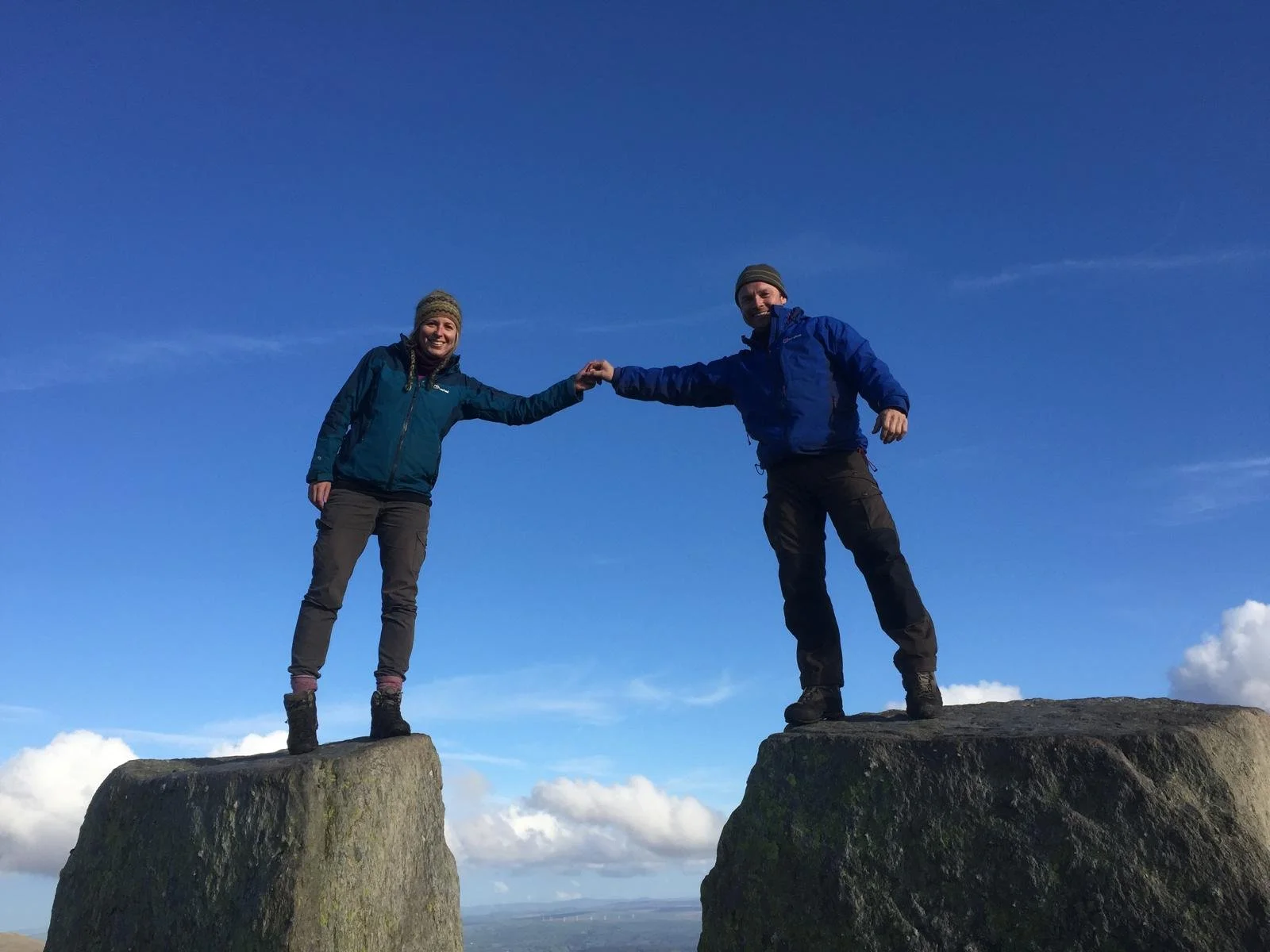
Neil and Emma Dennison - Founders of Urban Pursuit
My first memory of Neil goes back years, to a men’s breakfast organised in 2011. There was a bacon sandwich, a crowded table, and a conversation that in hindsight feels quietly prophetic. Neil was just about to resign as a deputy headteacher and was preparing to take what can only be described as a running jump into the unknown. Sitting with us was Pete Culliford, another entrepreneur in the city, who assured Neil with confidence that it was a ‘no-brainer,’ that it would work, and that he would probably be earning £200,000 the following year. It felt simple, obvious, almost inevitable. Hmmm
Neil laughs about that now. None of it happened like that. Not the speed. Not the ease. Not the financial trajectory. What followed was far harder than he ever imagined, filled with more uncertainty, more pressure, and far more patience than he expected. And yet, the impact has been far greater than he could have dreamed. As Neil reflected over coffee, God was glorified through the journey, not through speed or success or wealth, but through faithfulness, obedience, endurance, and long-term fruit.
Calling, not comfort
Neil married Emma in 2009, and from the beginning they imagined a future where their work would overlap. Both loved the outdoors, both believed in education as formation rather than simply instruction, and both sensed that their lives were meant to be integrated rather than compartmentalised. Neil was a promising maths teacher working in several secondary schools, with a secure and successful career ahead of him, but they didn’t want to give ninety-nine percent of themselves to something safe and one percent to what they believed they were called to. They wanted to give everything. They didn’t want to reach sixty and look back wondering if there was more they could have done, more they could have given, more they could have stepped into.
So the Monday after that men’s breakfast, Neil handed in his notice. Urban Pursuit was born.
What Urban Pursuit does

Urban Pursuit exists to care for children at risk of exclusion from mainstream education.
It provides alternative provision through activity-based learning and relational mentoring, using the outdoors as both classroom and catalyst. Through sailing, climbing, mountain biking, skateboarding, bushcraft and wilderness skills, it reimagines education for children who do not thrive in traditional systems. Today it works with over thirty schools, supports well over one hundred students, and employs more than thirty staff across Bristol, while also acting as a catalyst for other organisations stepping into the alternative education space across the city.
The unreasonable entrepreneur
Neil never started with a neat problem statement. This was not a business idea looking for a market, but a calling that already lived in his heart. He describes it as a journey of discovery rather than execution, a path where the problem revealed itself as he walked it. He was deeply aware of how easy it is to become someone who simply complains about the world, blaming systems, institutions, and governments, and he was determined not to live that way.
“One person will walk past a dripping tap and grumble. Another person will fix it. What are you doing about it? Don’t just sit there moaning. What are you going to do?”
We reflected together on George Bernard Shaw’s famous line:
“The reasonable man adapts himself to the world: the unreasonable one persists in trying to adapt the world to himself. Therefore all progress depends on the unreasonable man.”
— George Bernard Shaw, Man and Superman (1903)
Neil Dennison has been precisely that kind of unreasonable entrepreneur, not driven by ego or ambition, but by a refusal to accept that broken systems must remain broken. His childhood story of poverty, instability and insecurity did not make him passive; it made him determined. Being shaped by family breakdown and financial scarcity did not teach him to accept the world as it was, but to imagine how it could be different. In that sense, his origin story and his vocation are inseparable: the boy who grew up in poverty became the man who refused to accept broken systems as inevitable.
Exhaustion, resilience and community
Another theme that surfaced in our conversation was exhaustion, not just personal, but communal. Neil has watched countless entrepreneurs fall away over the years, not because their businesses were dead or their ideas were wrong, but because they simply could not keep going. They were tired, discouraged, emotionally empty, and spiritually drained. He reflected that many ventures do not die from lack of viability, but from lack of resilience.


This, for Neil, is one of the deepest reasons Christian entrepreneurial community matters. There are many kind people and many supportive people, but only those who have walked that road, who have faced payroll fear, exhaustion, doubt, pressure, shame, and the quiet sense of defeat, can truly understand it.
That is why spaces like Bristol Spring matter. Because in that same café, sipping coffee, there are other people at other tables who have been there too. They carry the scars, they know the road, and they understand the cost. Sometimes that shared understanding is what keeps someone going another year.
Faith, obedience and slow provision
In the early days, Neil recalls a prophetic image that shaped how he understood the journey ahead. It spoke of trust in God’s provision and of God shaping his heart through the work itself. He is honest that it would have been nice if obedience had been repaid with instant success, but what came instead was something deeper and more lasting.
Over fifteen years, he can name at least five moments when he wanted to give up. There were payroll crunches, emotional burnout, and seasons where he had to borrow from friends and family to make payroll while not being paid himself.
“We nearly gave up five times… but somehow we would just kind of bump along and get through another year.”
Neil reflects that the hardest part of entrepreneurship is not execution but emotional resilience, the capacity to persevere when things are hard, when there are no clear answers, and when walking away would be easier.
A city that caught up with the vision
The timing of Urban Pursuit has proved prophetic. Post-smartphone culture, post-lockdown trauma, and an explosion in youth mental health needs have left schools overwhelmed and systems stretched. Urban Pursuit became a solution for children that mainstream structures simply could not support, not because it scaled fast, but because it was faithful.
Not every story is a success story. Neil speaks honestly about the attempt to launch Urban Pursuit in Cardiff. While it was welcomed in a handful of schools, it was not embraced across the city and ultimately failed. It was a deep disappointment, not only strategically but emotionally, because when your work is your calling, failure does not just affect the organisation, it affects your identity.
Money, mission and redefining success
Neil’s relationship with money is deeply personal. Childhood trauma shaped it through family breakdown, poverty, free school meals, and growing up without financial security.
“I was traumatised as a young person… we were put into poverty at the age of 13… we were on free school meals… only had two or three sets of clothes… and I decided I was never, ever going to be poor again.”
Those experiences left scars, but they also created drive, a determination that his own children would never experience that insecurity, and a refusal to tolerate systems that allow children to suffer unnecessarily.
This led him into a radical rethinking of profit and success. He challenges the myth of “dirty profit” in the third sector, where low pay is sometimes spiritualised and financial ambition treated with suspicion. “The best people don’t go into that [third sector]… because they can’t be rewarded at the level they would be in the private world.” and “Why would you start as a charity if there’s already a commercial model that works?”
Neil is blunt about the downstream consequences of this thinking. The assumption that profitable enterprises in the third sector are somehow morally suspect does real damage. It quietly shapes who chooses to take on society’s hardest problems. When profit is treated as dirty, the people with the highest levels of skill, resilience, and entrepreneurial capacity are subtly pushed elsewhere.
“If there were a clear, proportional link between social impact and profit, Urban Pursuit would have made a fortune.”
Its contribution to children, families, schools and communities is incalculable. And yet the cultural imagination struggles to reconcile profit with purpose.
People have no issue with James Dyson becoming enormously wealthy through vacuum cleaners. But the moment someone builds something financially successful in the third sector, suspicion appears. Motives are questioned. Intentions are doubted.
For Neil, this contradiction exposes something broken in our moral imagination. If we want the best people solving the hardest social problems, then building financially strong, high-impact enterprises in the third sector should not be viewed with suspicion, but with gratitude and encouragement.
For Neil, if an organisation creates massive social value, it is not immoral for it to be financially healthy. It is necessary.
A new season of leadership and imagination
Neil is now Chairman of Urban Pursuit, having passed the CEO role to his long-time partner Dan.
“I learned that I couldn’t just use my heart. I actually had to use my head as well.”
It has created space for new thinking, new dreaming, and new vision, with future ideas ranging from solving systemic bottlenecks in EHCP processes, to robotics in mainstream education, to mental health initiatives for men rooted in the outdoors and honest conversation.
Expecting big things

Neil remembered an old MINI Countryman campaign tagline that stayed with him during the hard times.
“Expect big things.”
Urban Pursuit did not become big in the way the world defines bigness, but it became deep, trusted, and transformational, quietly reshaping how a city cares for some of its most vulnerable children.
As Neil reflected on the journey, he said:
“Would I trade back to where I was 15 years ago? Absolutely not.”
Sometimes the greatest impact is not loud or visible. It is faithful, persistent, and unreasonable. And sometimes it begins with nothing more dramatic than the courage to step into the unknown.