
Wild flowers Vs Rose Gardens
I met with my friend James this morning and we discussed the ways of God, in the idea of wild flowers, bees and butterflies.
Did you know:
Wildflower “mini‑meadows” in UK gardens attracted, on average, 111% more bumblebees, 87% more solitary bees, and 85% more solitary wasps than control lawns without wildflowers. Source
This is not about bees - keep reading.
Spring was birthed out of a rather simple idea: to cultivate friendships between Christian entrepreneurs in the city of Bristol, providing care and support to one another, and with the gentle hope that, over time, this relational soil might also give rise to collaboration on meaningful projects — and perhaps the occasional spark of genius that leads to new, exciting, even transformational businesses being launched.
Wild Flowers Versus Rose Gardens
This past year has felt less like building a polished model and more like learning, together, what actually creates life. We’ve been paying attention to small, often quiet things: what builds friendship and trust between entrepreneurs, what gives rise to momentum that doesn’t feel forced, what seems to release creativity, courage and a deeper imagination for what business might become when God is gently welcomed in rather than tightly managed.
There have been moments of clarity and moments of confusion. Times when energy flowed and times when it felt fragile. And in that, we’re noticing something important:
Much of what really matters cannot be engineered. It can only be received, stewarded, and protected once it appears.
This has not been about having the answers, but about learning to listen together.
Why the Wildflower Garden Matters: Bees, Biodiversity and Kingdom Life
This is not merely a poetic contrast, It is ecological, spiritual, and — perhaps surprisingly — helpful idea for those of us seeking to cultivate Kingdom life within the entrepreneurial landscape of Bristol.
Research from institutions such as Rutgers University, UC Davis, the Xerces Society, and peer-reviewed journals including PLOS One and the Journal of Applied Ecology shows that wildflower gardens support between two and ten times more individual bees, and three to six times more pollinator species, than manicured rose beds or tightly mown lawns. When mowing is reduced to once or twice a year, pollinator numbers can triple in a single season. Hybrid roses, bred for visual perfection, offer minimal nectar.
By contrast, diverse native wildflowers feed pollinators across most of the year, creating resilient ecosystems of interdependence and renewal. Urban wildflower strips have been shown to increase pollination services by up to 86% compared to sterile ornamental planting.
The less we impose rigid control, the more life tends to emerge.
And the more space we create, the more abundance appears.
This feels strangely close to the way the Kingdom of God so often works.
A Culture of Entrepreneurial Community in Bristol
As we reflect on the culture taking shape among Bristol’s entrepreneurs — particularly where faith and business gently intersect — there is a growing sense that we are not constructing something highly curated or tightly branded, but inhabiting something more organic, relational and alive..
A wildflower garden does not begin with a detailed blueprint. It begins with permission: permission for the ground to be what it is, for seeds to land where they land, for the soil and the wind and the unseen networks beneath the surface to do their slow work. There is intention, yes — choices about what not to control — but life itself is not forced. It is received.
Creating Space for the Unlikely
In a similar way, Spring has felt like a space we are stewarding rather than a model we are imposing. A place where people can exhale a little. Where they do not need to arrive fully formed or perfectly defined. Where ideas can hover in half-light, still becoming, still tentative. Where questions are not rushed into answers.
This is not a rejection of excellence. Nor is it anti-structure. It is simply a growing awareness that fruitfulness does not only come from precision. Sometimes it comes from trust. From patience. From resisting the urge to prematurely label outcomes.
A rose garden looks extraordinary. Its order is reassuring. Its clarity impressive. But it seldom surprises. Everything that does not align with its shape is slowly removed.
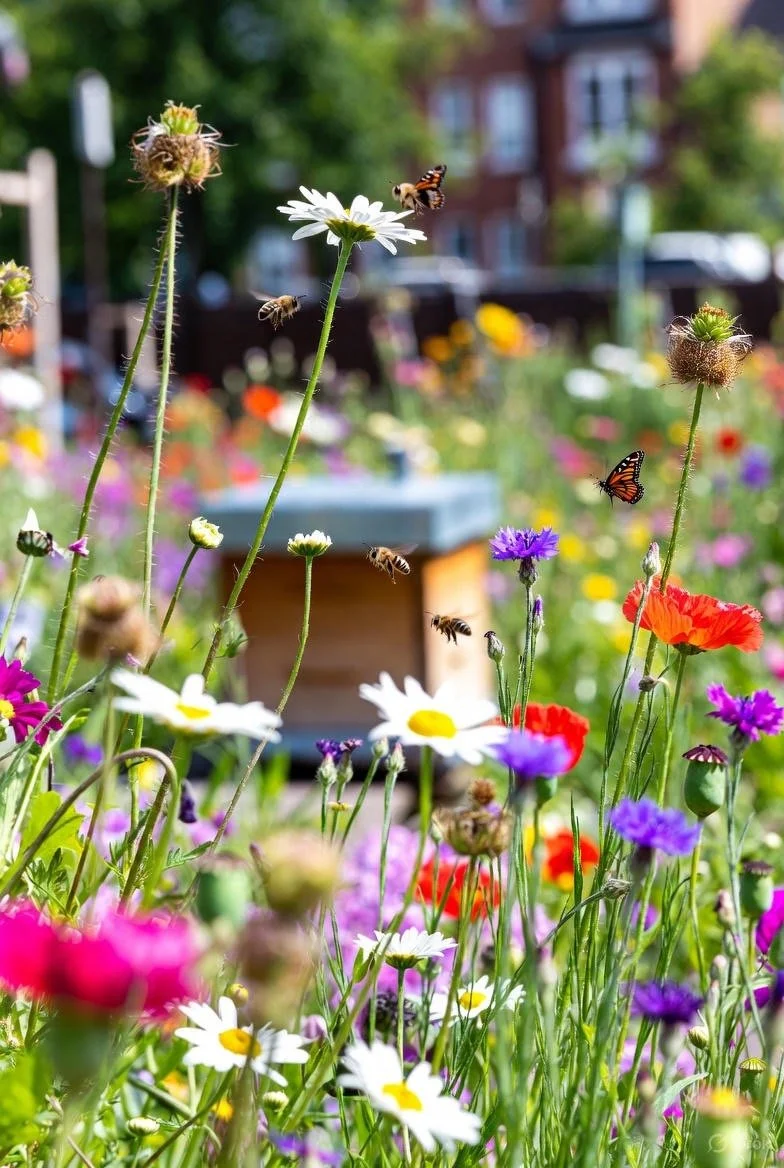
A wildflower garden, by contrast, is a little unruly. Yet it hums with life. Bees drift unpredictably. Colours appear where no one planned them. Seeds travel further than anyone intended. Beauty arrives on its own terms.
Faith, Business and the Wind of the Spirit
When we create environments marked by openness, people tend to lean in. When we allow space for the unlikely something more authentic begins to take root. Not because we engineered it, but because we did not close it down too quickly.
The Kingdom seems to breathe like this. Not hurried. Not overly managed. Moving gently, yet persistently, through what is vulnerable and unguarded. Flourishing not in spectacle, but in steady presence. Dare I say it, a little like yeast in dough or salt being sprinkled, or fragrance being spread. Now where did I hear that?
What Are We Really Saying?
So what are we expressing, both as a community and as individual businesses seeking Kingdom purpose? This is not just about Bristol Spring but about the lives of entrepreneurs and founders.
Perhaps simply this: that entrepreneurs are not just problem-solvers or growth machines, but people formed by love, story, failure, prayer and longing. That business can be a place of obedience, creativity, repentance, joy and hope. That God is not only interested in outcomes, but in the hidden formation taking place along the way.
We are learning to pay attention to what brings life, and to follow that gently.
Allowing the Wind to Blow
John 3: 8 The wind blows wherever it pleases. You hear its sound, but you cannot tell where it comes from or where it is going. So it is with everyone born of the Spirit.”
There is a sense that our role is not to tightly control growth, but to remain responsive. To allow the wind of the Spirit to move as it will — through our businesses, through our relationships, through our hearts.
Seeds fall in unexpected places. Some will grow quickly, others slowly, some not at all. And yet, there is beauty in this uncertainty, because it keeps us dependent. It keeps us humble. It keeps us open to surprise.
Life in the Wildflower Garden
The image that continues to return is that of a wildflower garden — and it’s one that feels close to home in more ways than one because our neighbour Richard, tends a garden of perfect right angles, symmetrical trellises and impeccable order. It is the kind of garden worthy of a man who spent 45 years as an engineer — precise, disciplined, and quietly impressive.
By contrast, ours is a little messier, a little more chaotic, with fewer straight lines and far more surprises — and yet it hums with life. Bees bumble, wildflowers crowd in, and colour seems to arrive where it was never invited. The wildflower garden does not proclaim itself superior to the rose garden. It simply bears witness to another way of living: open, relational, collaborative, quietly abundant and one that multiplies bees and pollination 6-8X .
John 3: 6 Flesh gives birth to flesh, but the Spirit gives birth to spirit. 7 You should not be surprised at my saying, ‘You must be born again.’ 8 The wind blows wherever it pleases. You hear its sound, but you cannot tell where it comes from or where it is going. So it is with everyone born of the Spirit.”