
More Than Bricks and Mortar
How Will Matthews Is Reimagining Power, Property and Stewardship in Bristol
By Brad Askew

Will & Jo
At our last Spring Deeper night we gathered in the garden marquee at the Gloucester Old Spot and we listened to something both deeply ordinary and quietly radical.
Will Matthews stood up to talk about property. Not revival. Not mission overseas. Not church planting.
Property.
On the surface, it is an industry most Christians approach with caution. It carries baggage: power imbalances, profit margins, tired magnolia walls, tenants with little voice. Yet what unfolded over the evening was not a defence of landlords, nor a carefully sanitised testimony. It was the story of a man who had to unlearn the idea that God was uninterested in his work — and who is now discovering what it looks like to practise discipleship in one of the least glamorous sectors imaginable.
What struck me most was not what Will is building, but how he now understands why he is building it.
“I Just Thought God Wasn’t Interested”
Will’s journey into business was not the result of a dramatic calling moment. It was almost inevitable. He comes from generations of self-employed entrepreneurs. “You have to go back to my great-grandparents to find someone who had a job,” he said with a smile. Entrepreneurship was simply the family language.
After finishing university and returning to Bristol, he had no intention of working for someone else. An opportunity arose to manage a portfolio of properties. Armed with youthful confidence — “that slightly arrogant, ‘yeah, of course I can do that’ confidence,” as he described it — he stepped in.
Over the next few years, he learned property the hard way: the deals, the pressure, the unpredictability. And he loved it.
But at church, something didn’t quite sit comfortably.
Surrounded by friends working as doctors, nurses, educators and charity workers, Will became increasingly aware of an internal narrative forming. In his church home group, there were just three from the “private sector”: a banker, a lawyer and himself. “You get the little comments,” he admitted. Nothing overt, but enough to reinforce a subtle hierarchy of virtue.
Gradually, work became compartmentalised. Faith belonged on Sundays. Business belonged elsewhere.
“I just thought God wasn’t interested,” he said plainly. “He’s interested in the virtuous jobs. He’s not interested in landlords.”
That belief lingered for years.
The Question That Unsettled Everything
Three years into building his property portfolio, Will and I met for coffee. He enthusiastically described what he was doing, the growth, the strategy. I asked him a simple question: “What’s the long-term vision?”
His response was immediate and well rehearsed. “I’m going to set up a social enterprise.”
It sounded impressive. Noble, even. The kind of answer that sits comfortably in Christian circles.
I have said similar things and not acted on it so I asked him what that actually meant to him.
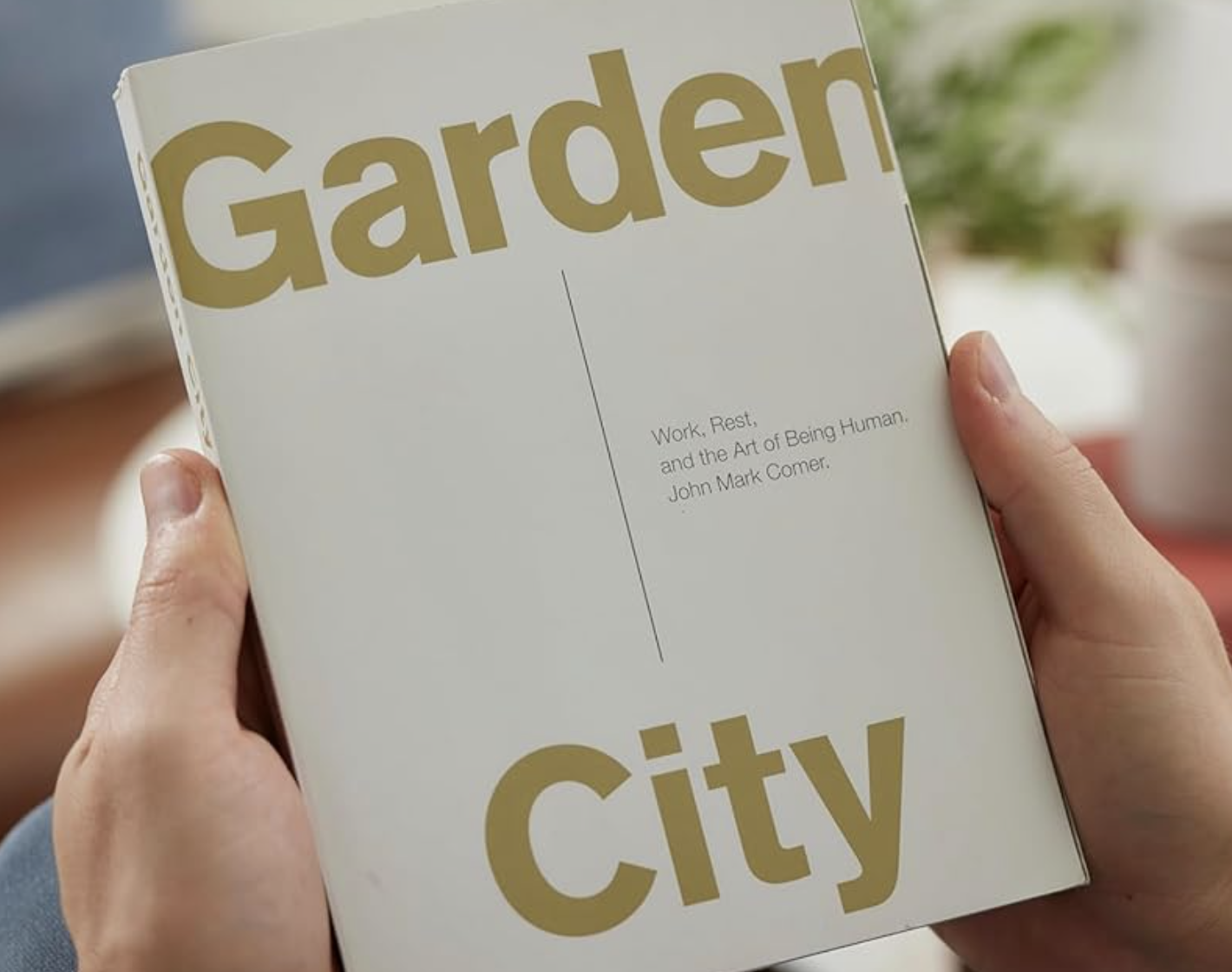
Garden City by John Mark Comer
He couldn’t answer.
“The truth is,” he later admitted to the room, “I had no intention of setting up a social enterprise. It just sounded good.”
That moment of honest exposure led us to read Garden City by John Mark Comer together. The book explores the integration of faith and work, arguing that redemption is not limited to souls but extends to systems and structures.
For Will, it was catalytic.
One idea in particular lodged deeply: work was original to creation. Before the fall, there was cultivation, leadership, responsibility. Work was not punishment; it was participation in God’s ongoing ordering of the world.
Another line reshaped his thinking entirely: redemption includes systems, not just individuals. Industries can be transformed.
That changed the frame.
Property was no longer a morally neutral income stream. It was a system capable of reflecting either exploitation or restoration.
Power, Systems and the Human Element
The property industry is built on power differentials. Landlords hold assets; tenants need homes. That asymmetry can either be stewarded carefully or exploited quietly.
Will had seen what exploitation looked like. Houses painted magnolia decades ago and never improved. Properties “milked” for maximum yield. Tenants locked into rigid contracts with little flexibility or voice.
As he described it, the temptation in business is always toward optimisation. Systems can become slick, automated and impersonal. Maintenance reported through portals. Tenants reduced to data points. Human mess filtered out.
“You can optimise everything ” he said. “But you’re dealing with messy humans. You can’t automate messy humans.”
That insight has reshaped how his company operates.
They remain a for-profit business — unapologetically so. “I’m not looking to break even,” he said. “I’m looking to make money. Because then I can buy more houses and do more with it.” There was no embarrassment in that admission.

But alongside traditional metrics — occupancy rates, margins, growth — they now track what he calls “God-centred KPIs.” Tenant satisfaction. How quickly contractors are paid. Whether neighbours have direct contact. Whether people feel heard.
Contractors are paid the same day work is completed. It costs nothing, yet it signals dignity. Tenants receive annual surveys asking if they feel listened to. Contracts have been made more flexible, even before legislation required it, because forcing someone to remain in a room after losing a job “just didn’t sit right.”
Over time, this approach has produced something unexpected: influence. In a concentrated area where Will controls a significant percentage of rental rooms, others have begun to adapt. When tenants prefer properties where they are treated well, competitors are forced to respond.
Redemption, in this case, spreads not through proclamation but practice.
The Question of Wealth
One of the most searching moments of the evening came during Q&A. Chloe asked what many Christians quietly wonder: isn’t wealth dangerous? Didn’t Jesus warn repeatedly about money?
The question deserves seriousness.
Jesus does warn about wealth. Money can create an illusion of independence from God. It can easily become master rather than servant.
Yet the conversation that followed was nuanced. The issue, as we discussed, is not scale but stewardship. In the parable of the talents, some are entrusted with more and expected to multiply it. The danger lies not in possessing resources, but in allowing those resources to possess you.
We spent some time exploring the biblical tension around wealth and responsibility, recognising that Scripture refuses simplistic conclusions. In Deuteronomy we are reminded that it is God who gives the ability to create wealth, not as an end in itself but so that blessing might overflow to others.
The conversation naturally moved to Jesus’ parable of the rich fool — the man who tears down his barns to build bigger ones, hoarding his grain only to discover that his life will be demanded of him that very night — a sobering reminder that accumulation without purpose ultimately collapses under its own weight. And yet, set alongside that story is Joseph, the dreamer in the technicolour coat, who likewise stored grain in years of abundance, almost certainly building bigger barns, but did so in obedience to God and for the salvation of many during famine.
The contrast is striking. It suggests that the issue is not the size of the barns, nor even the scale of wealth, but the deeper “why” behind the activity — whether resources are gathered for self-preservation or stewarded as part of a redemptive purpose.
Will does not pretend the tension disappears. Running a growing portfolio means constant decisions where profit and patience pull against each other. But the shift in his thinking has been from guilt to stewardship.
There was a time when ambition itself felt suspect, as though smaller vision equalled greater holiness. That belief has been dismantled.
“God isn’t threatened by scale,” Will said. “He’s more concerned with the direction you’re going.”
For Christian entrepreneurs, that sentence alone is worth lingering over.
Ordinary Faithfulness in an Unremarkable Industry
Perhaps the most compelling aspect of Will’s story is its ordinariness.
This is not a dramatic pivot from corporate excess to charity work. It is not a tale of abandoning business for ministry. It is discipleship within bricks and mortar.

He now runs multiple property-related ventures, including an unglamorous but growing garage portfolio — “a box with a roof and a door,” as he described it with delight. No one else wants it. Which, in his view, makes it full of possibility.
He introduces himself to neighbours whenever he buys a property, giving them his number so they feel they have a voice. He mentors other investors around the country, most of whom are not Christians, and finds himself asked regularly why he does things differently.
It is quiet work. Incremental. Largely unseen.
And yet there is a sense, watching him, that something deeper has aligned. The earlier compartmentalisation has dissolved. Work no longer competes with faith; it expresses it and also forces other landlords to change their way of doing things so they can compete. This is what change and reform look like.
During prayer week someone shared a simple image that has stayed with us: a single drop of food colouring falling into clear water, almost unnoticed at first, yet slowly spreading until the whole glass is transformed. It felt like a quiet parable of faithfulness. The kingdom rarely advances through spectacle; more often it moves through small acts of obedience that, over time, alter the atmosphere around them. What begins as a seemingly insignificant response to God’s prompting may, in time, reshape the culture of a street, a neighbourhood, even a city.
He summarised the journey with a line that stayed with many of us:
“Work is where my faith has teeth.”
Building With God
As the evening drew to a close, Will offered one final thought that captured the heart of his journey.
“God didn’t ask us to stop building. He asked us to build with him.”
That is not a slogan. It is a theological reorientation.
For too long, many Christian entrepreneurs have felt they must either sanitise their ambition or escape business entirely to prove spiritual seriousness. Will’s story suggests another way: remain where you are, but reimagine how you operate. Examine your systems. Reconsider your metrics. Notice who holds power — and how you might redistribute it wisely.
He is ten years into this journey and describes himself as perhaps “one percent of the way through.” There is no triumphalism. Only steady obedience.
And perhaps that is precisely how industries are redeemed: not through spectacle, but through people who quietly refuse to separate their faith from their work any longer.
In a sector often criticised for exploitation, that refusal may prove more powerful than we yet realise.