
Simon Jones: Corporate Law Reimagined
Jazz, Vulnerability, and Early-Stage Wisdom
By Brad Askew

Simon Jones
Over coffee in the familiar surroundings of Boston Tea Party at the top of Whiteladies Road, with its easy mix of locals, students and independent energy, Simon Jones talks openly about his life and work. A thoughtful corporate lawyer reflecting on the path that has brought him to this point and we stumbled upon a fascinating link between his love for jazz and his love for early stage businesses which has perhaps been hidden in plain site.
Simon remains very much a corporate lawyer, specialising in working with founders on equity fundraising, venture capital, private equity investments, M&A and company structuring for growing businesses. After many years as a partner at Osborne Clarke in Bristol, he joined Temple Bright at the end of 2024.

Temple Bright is different to traditional law firms. It is a collective of around 80 partners based in Bristol and London, most of whom were partners in large firms, with each partner operating their practice on an independent basis. With its streamline structure (no juniors, low overheads and no financial targets), the change has given him greater freedom to choose his clients and to make his services more accessible, particularly to early-stage founders who often delay taking proper legal advice because of cost. “I’m free to spend my time how I want to spend it and love working with inspiring founders of innovative businesses,” he says simply.
Roots in Music and a Search for Structure
Simon Jones playing Jazz
Simon’s early years were steeped in music. “I was playing piano at three, clarinet at seven before finally being old enough to play the instrument I always wanted to, the saxophone at ten,” he recalls. By the age of 15 he was playing gigs in pubs, immersed in the world of bands where improvisation and listening to one another were essential. A music degree followed, but the need for a more secure path led him to law. “Music was my life all through being a young kid,” he says, yet he chose the logic and stability that a legal career appeared to offer.
Brought up Roman Catholic, he found church services distant and hard to connect with—“I didn’t understand a word,” he admits—and by adulthood he had become a passionate atheist. Law provided a new kind of rhythm: structured, intellectually demanding, and materially rewarding. Music never entirely disappeared from his life. Years later, a friend showed him a gospel video, and something stirred: “My goodness, this is amazing. So much energy and soul.” It was an early hint of connections beyond the purely rational.
Building a Career in Corporate Law
At Osborne Clarke in Bristol, Simon developed a strong practice in corporate law, focusing on helping companies raise equity and guiding them through growth to eventual exit. His work was roughly balanced between venture capital firms and the companies themselves, though his preference was weighted towards working with founders: “acting on the company side allowed me to develop a long-term relationship with them as a trusted advisor and go on the whole journey with them. OC was always a very well managed firm and placed great importance on supporting its people” Simon states, however working in a large international firm came with a high-pressure environment. Much of his work took him to London, and the Bristol scene felt secondary. The pursuit of material success—“bigger houses, bigger cars, lots more money”—gradually became linked to his identity.
Complex Deals and Growing Dissatisfaction
The work itself could be absorbing. He remembers Funding Circle’s $150 million Series E round: “We had about eight VCs. Big American VCs, each of them having different lawyers involved... It becomes like a layer cake with everyone having different opinions and objectives”. Yet over time the lack of deeper satisfaction became clear. “I’m not getting job satisfaction out of this. It’s very stressful,” he realised. Gospel music on his runs became an emotional lifeline: “I was drawn to the emotion, the connection.”
Deeper Reset
All of us found the COVID period and lockdown very stressful and Simon’s experience was no different. During this time a set of coincidental circumstances led him to meet a very talented guitarist at a local jam session. That man turned out to be Charles Campbell, the Pastor of the Church of God of Prophecy in Gloucester. It was a meeting that changed the course of Simon’s life and faith journey. A few days after meeting Charles, Simon was performing with the church worship group,
“I distinctly remember the lead singer reminding us that this was worship and not performance – something just takes over when I play on stage at church, I’m playing to and for an audience of one”.
Shortly after joining Temple Bright, Simon’s world was rocked when a very rare auto-immune condition led to heart failure and a 4 week all-inclusive stay at the Heart Institute at the BRI. However, Simon looks back at the experience with huge gratitude, the whole experience was “a complete physical, mental, spiritual reset.” While in hospital he would go to the foyer piano and play gospel tunes such as “Goodness of God.” One morning a patient about to undergo open-heart surgery listened quietly. “Thank you... You’ve just taken my mind off what I’m about to do... I don’t feel any anxiety anymore,” the man told him. In the midst of personal fragility, moments of unexpected grace appeared.
A New Model for Corporate Law Practice
2025 was very much a year of recovery and a journey back to full health. “I am confident that 2026 will be far better year for me as I look to grow my local network and law practice, although I never forget that I’m not the one in charge and (just like in Esther 4), sometimes you just have to be in the right place at the right time.
He continues to practice corporate law, advising on investments, structuring and exits, but with the flexibility to work with earlier-stage companies. He values the direct relationship with clients:
“It’s alignment. It keeps you honest because if they’re not happy, the feedback loop is really tight.”
He stresses the importance of early conversations, particularly for founders: “for example, if there’s more than one founder, you’re going to have to think about what you do in terms of putting some form of agreement in place that might be binding, that deals with worst-case scenarios.” A shareholders’ agreement is not simply paperwork; it requires honest discussion: “Have you considered the strength of your relationship? What happens things go wrong?”.
Within communities such as Spring he is approachable:
“Number one, I’m within reason always available, and willing to have conversations with people to provide ad hoc advice and help Spring members in any way I can – I see it as a form of service.”
The Jazz Connection: Listening and Improvising
Music remains a vital part of who Simon is.
“I never really play for audience members. I play for the musicians,”
The parallel with his work is striking:
“entrepreneurs need to think creatively... you will be challenged every single day and you’ve got to find a way through that.”
In jazz, as in advising founders, there is the need to respond in the moment: “If I’m given a chord sequence to solo over, I’ve got to come up with something to get from A to B.” His approach to legal advice is collaborative:
“It is often required to take a step back and think... What are you trying to achieve? what’s your goal here? And how are we going to reach that goal?... It goes far beyond the law... it requires commercial and pragmatic creative thinking, for example, how you communicate... Is it email? Is it phone call? Game theory. All that stuff.”
Integrity and a Changed Perspective
Faith has quietly reshaped Simon’s priorities, drawing on passages about generosity and the dangers of treasuring earthly things: “That really underlines my transition. The question he now asks is straightforward: “What can I do to help?”—even when it does not lead to paid work.
Looking Ahead: Depth Rather Than Scale
Health recovery and financial stability remain priorities: “I’m fairly consumed with focusing on my health recovery and getting some stability at work.” He would like to see better signposting of resources across the Southwest —“It’d be fantastic to have some kind of newsletter... aggregate all for everyone”—so that the community can “serve the community, not compete.” We reflected that just maybe this is something we as Spring can lead in.
A Quiet Harmony
Simon’s journey—from a young musician who once dismissed faith, through the pressures of corporate life and overcoming acute illness —shows a resilience shaped by connection and reflection. In the quiet improvisation of jazz or in thoughtful conversation with founders over coffee at Boston Tea Party, he is helping to make corporate law more human.
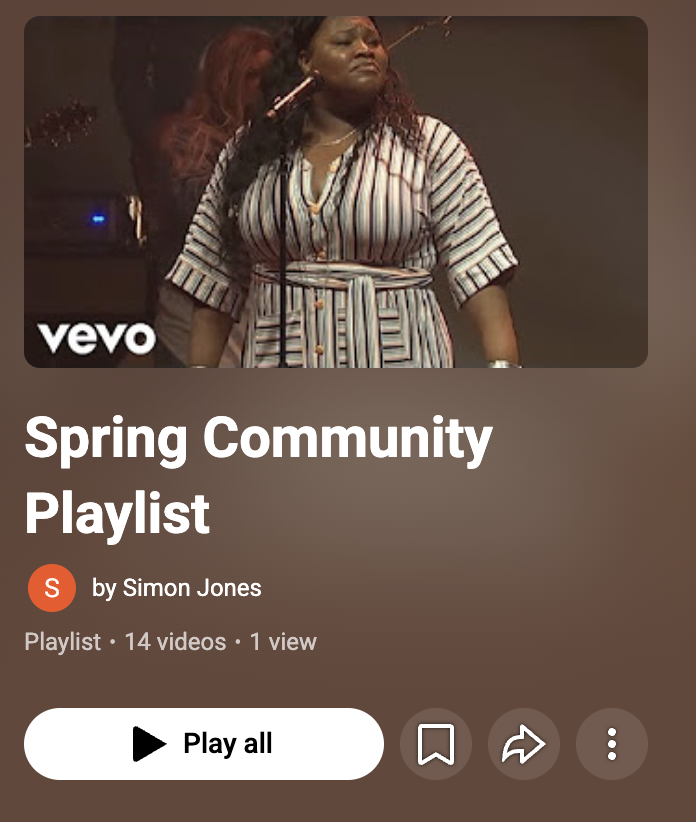
Simon has put together a YouTube mix of Gospel songs that have been instrumental in his journey. Click image: >>>