
The Courage to Speak Truth in Love
Grace and Truth in the Entrepreneur Community
By Brad Askew
How honest and truthful are you with other entrepreneurs?
In any Christian community, the tension between care and truth comes up from time to time. At Bristol Spring, we aim to be people of care, grace, and truth—but sometimes the truth we need to share is painful. Yet truth is like oxygen: essential for life, even when it stings.
As Proverbs 27:6 reminds us,
“The wounds of a friend are better than the kisses of an enemy.”

We can have countless people cheering us on, yet without the courage to speak truth, that cheer can sometimes become dangerous. In the communities we are building, our goal is to create a culture where honest, helpful feedback is not only welcome but actively encouraged—even if it feels awkward in the moment.
Be honest, have you ever sat with someone sharing their next big idea and nodded and smiled while quietly thinking it was flawed from the outset—and yet said nothing?
And have you ever asked someone to be brutally honest about a business situation, only to hear something you really did not want to hear?
Why Speaking Truth is an Act of Love
Love is often misunderstood as always being agreeable, or palatable. But the biblical picture of love involves willing the best for another person, not simply avoiding conflict to maintain likeability. This distinction is vital in entrepreneurial communities, workplaces, and churches alike.
I recall a time not too long ago when I was exploring and Airbnb for meals (it was called Sharemytable). I was speaking with conviction and excitement—but my friend Tom looked at me and said,
“I think you’re actually bored of this idea before you even start. Your words are excited but your eyes look a bit bored!”
It was hard to hear, but looking back, it was one of the most loving things anyone could have said. He wasn’t seeking to discourage me; he was seeking to ensure my time, energy, and resources were not wasted.
On a recent walk with George Ladds he shared how a contact of his commented on something in his business which could create a regulatory risk in the future and how it made him feel cared for. He said,
“Being open to words from others is something we need to have when we sit down in front of someone. Sometimes we meet for advice, and sometimes we meet just to be heard—and there is a slight difference.”
What are we saying? Sometimes we need to read the room.
Loving one another often involves this delicate dance: balancing care with honesty. If we only pursue likeability, we risk offering empty praise, giving high-fives as someone metaphorically runs off a cliff. Conversely, if we speak truth without care, we become harsh and intimidating, and people will hide their thoughts and ideas from us.
Caring enough to challenge
The book Caring Enough to Confront illustrates this balancing act of truth and love using an XY axis. Imagine the X-axis represents truthfulness and the Y-axis represents care:
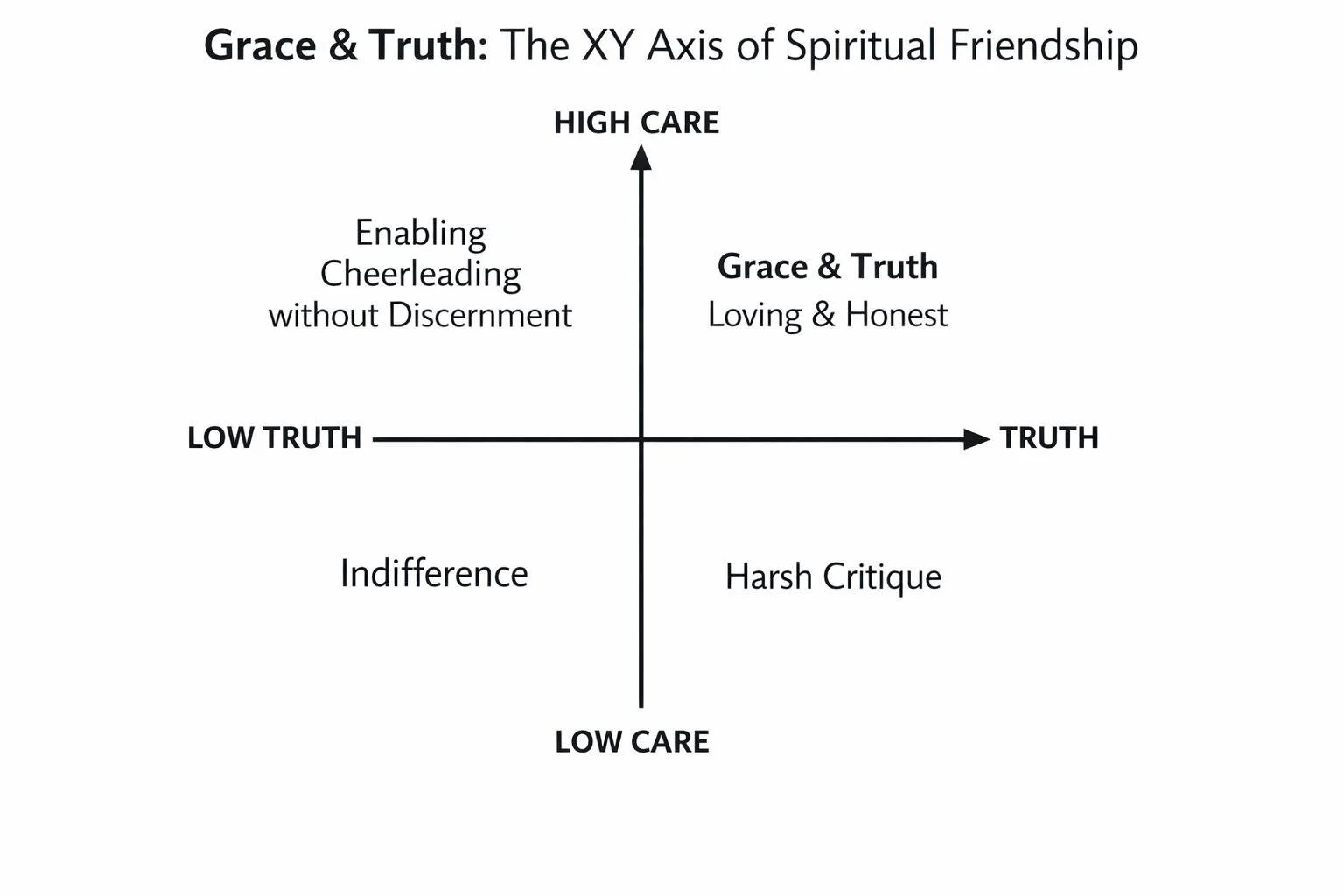
High care, low truth: This looks like cheerleading without discernment. It might feel supportive in the short term, but it ultimately leaves someone vulnerable—like letting them cross a road while a truck is coming, just to avoid hurting their feelings.
High truth, low care: This looks like bullying or harsh critique. It may be factually accurate, but it damages relationships and stifles authenticity. People will walk on eggshells, avoiding vulnerability for fear of being torn down.
Low truth, low care: This is indifference. It’s the opposite of Christlike love and leaves no room for growth or guidance.
Jesus, however, models the fourth quadrant:
High care and high truth. He was full of grace and truth simultaneously, never sacrificing one for the other. His truthfulness was an expression of his love; his love was always grounded in truth. In our communities, this should be the standard we aim for.
The Role of Grace in Truth-Telling
I am on your side.
Grace matters because truth without grace is toxic.
Pure oxygen kills. While essential for life, breathing high-concentration oxygen causes oxidative damage, potentially leading to lung damage, seizures, or death. It only sustains life when mixed with other elements - like nitrogen. Oxygen is just 20.95% of what we breath. Likewise, truth must be delivered with kindness, empathy, and an awareness of the other person’s heart.
In practice, this means that when we speak hard truths—whether about a faltering business idea, a relational conflict, or a spiritual pattern, we ensure that our words communicate,
“I am on your side”
When people know our intention is their flourishing, even difficult feedback can be received in a spirit of love.
Creating a Culture of Honest Care
How do we cultivate this balance in a community of entrepreneurs? I see three practical steps:
1. Build Deep Relationships
Truth without care only works where care exists. To speak honestly, we must first invest in relationship. Friendship and trust are the soil in which courage to speak and humility to listen can grow. At Bristol Spring, our community gatherings are designed to foster exactly this kind of environment: spaces where people can be authentic, vulnerable, and mutually supportive.
2. Are you brave enough?
Explicitly Invite Courageous Feedback
We need to give one another permission to speak what’s difficult to say. Paul reminds us that “you have many teachers, but not many fathers” (1 Corinthians 4:15). In a spiritual or entrepreneurial community, this means taking responsibility for one another’s journeys—not controlling them, but genuinely caring enough to speak up even if it is costly to us.
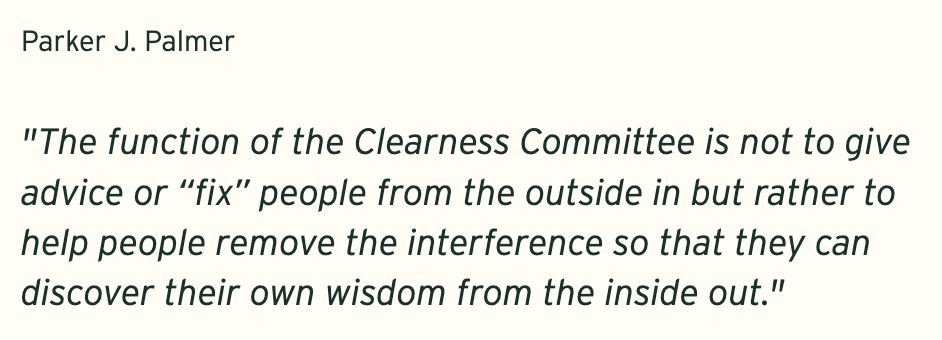
This might look like forming small trusted circles, similar to the Quaker practice of clearness committees. In these circles, a handful of godly, wise, and prayerful people ask the questions most of us are too timid to voice. These questions may feel bold or even uncomfortable, but they are motivated by love and the desire for flourishing.
You can downloads the guidelines here
3. Practice Reflection and Discernment
Receiving truth requires discernment. Not every critique is equally valid, and not every suggestion must be acted upon. But by consistently inviting accountability and reflection, we create a feedback loop that refines ideas, actions, and character. This is where grace meets truth: we listen with open hearts, weighing guidance through prayer and wisdom, while knowing that the intent behind the words is love, not judgment.
The Entrepreneur’s Reality
In entrepreneurship, just as in spiritual life, experimentation is essential. We try ideas, test markets, and sometimes fail—but discernment and accountability help us avoid costly missteps. A friend who tells you to reconsider an idea isn’t trying to deflate your dreams; they’re protecting your time, energy, and resources.
Sometimes, an idea doesn’t succeed—not because it is bad, but because it is a stepping stone to something greater. Our community can help us see the difference between fruitful failure and avoidable missteps. Grace ensures that failure doesn’t destroy us; truth ensures that we don’t repeat mistakes unnecessarily.
Speaking Truth in Love is Rare—and Precious
Friends willing to love us enough to sometimes disagree are rare. But these friendships are invaluable. They spur us on to love and good deeds, encourage maturity, and ensure our efforts are fruitful. At Bristol Spring, we want to nurture these kinds of relationships—spaces where care and truth coexist, where honesty flows out of love, and where people can grow safely in all dimensions of life.
By following Christ’s example—being full of grace and truth—we can speak and receive truth in ways that promote flourishing, authenticity, and trust. In a culture that prioritizes likeability or comfort, choosing care and truth may feel countercultural. But the result is worth it: a community that loves deeply, speaks honestly, and grows together.